

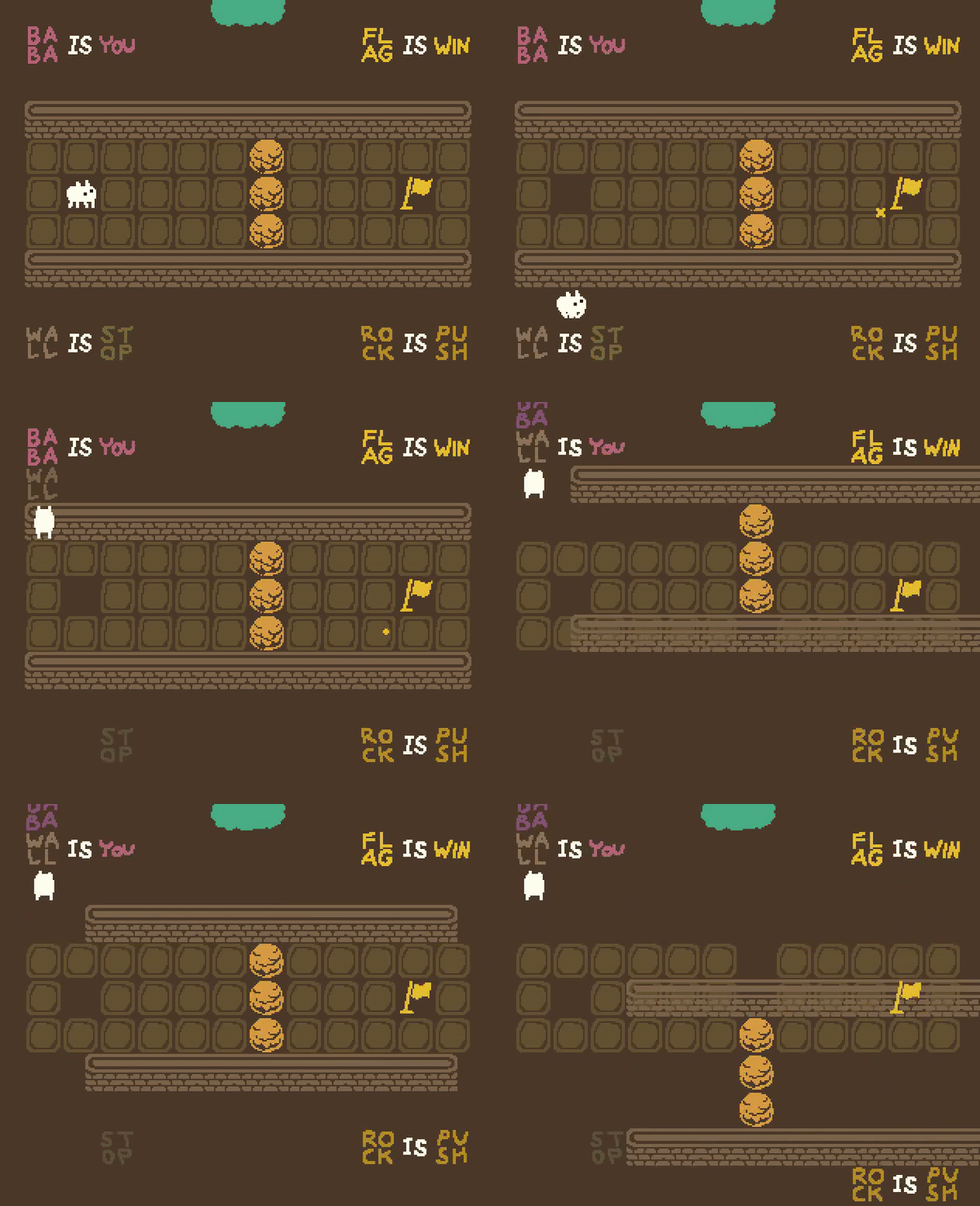
Initially, BABA IS YOU, meaning the player controls Baba (the little white creature), and WALL IS STOP, meaning nothing can pass through the walls. However, when the WALL piece is moved, the rule WALL IS STOP is broken, and now the walls can be passed through. Furthermore, when Baba makes WALL IS YOU, the player now controls the walls! Moving one of the walls over the flag wins the level.
Is this how you would solve the level? If not, what would you do?
How many ways do you think there are to win this level?
One of my all-time favorite video games is Baba Is You, "a puzzle game where the rules you have to follow are present as blocks you can interact with. By manipulating them, you can change how the game works, repurpose things you find in the levels and cause surprising interactions!" The gif above shows one solution to one level. The game is elegant in its simplicity, and some levels are brain-bendingly hard! The solutions all come down to logic and creativity, so naturally, it got me thinking about math.
The "rules" of mathematics, the properties of numbers and operations, are mysterious to many students who haven't yet had the opportunity to think deeply about them. What does it actually mean to add two quantities? Does the order matter? What about adding a negative quantity? What about adding a quantity you don't even know? Wouldn't it be interesting to have a visual representation of that rule to manipulate, and to imagine what happens when we change that rule?
In this project, students play select levels of the game Baba Is You and invent their own levels using mathematical operations. This project invites students to engage in logical reasoning through play and experimentation, and to refine their understanding of mathematical properties.


PLAY
Students begin the project with play, which ignites their curiosity, their creativity, and their joy.

PRODUCTS
Products include posters of mathematical properties (equality, identity, commutativity, etc.) and an interactive math puzzle.

RIGOR
Students write and test the "rules" of mathematical properties and operations; they use advanced logical reasoning and sequential operations to solve puzzles, employing Standards for Mathematical Practice.

SEQUENCE
This project would fit well as an introduction to the year or to lead into a unit on solving equations.

DIFFERENTIATION
Puzzles come in a range of difficulties, and the same puzzle can often be solved many different ways.

COLLABORATIVE DESIGN
Students will work in teams to design and test levels. The class engage in continuous dialogue about the rules of mathematics, proposing conjectures and offering proofs and counterexamples.